Public Relations in the Glocal Disinformation Society
DOI:
https://doi.org/10.5783/revrrpp.v15i30.927Keywords:
Public Relations, AI, Desinformation, Fake news, GlocalizationAbstract
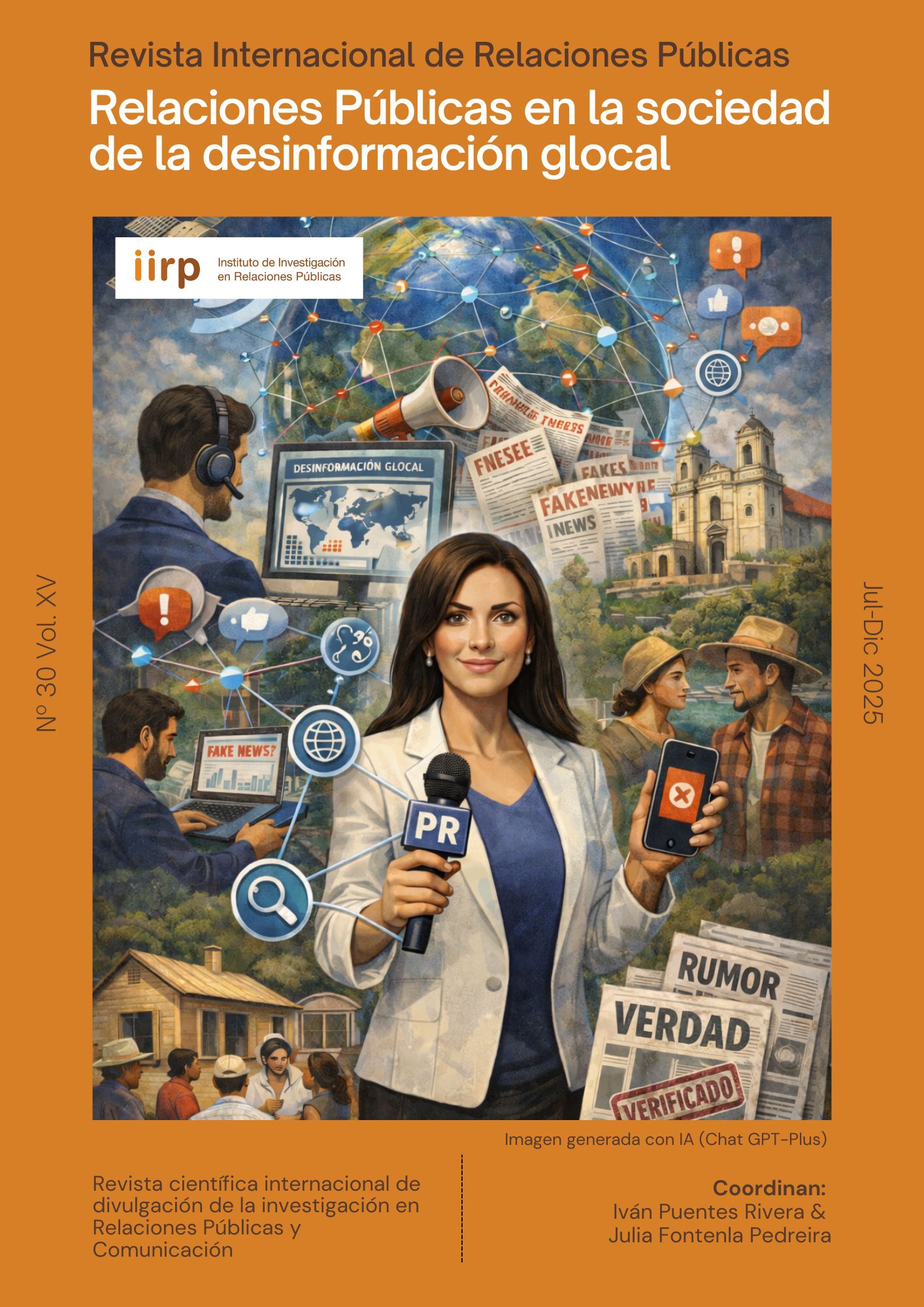
This latest issue of the International Journal of Public Relations Research focuses primarily on the so-called glocalization of disinformation, a phenomenon that refers to the global circulation of false, misleading, manipulated, or hateful content that is adapted to local realities, thereby increasing its persuasive effectiveness and appearance of truthfulness. Hoaxes and, in general, the discourses and communicative practices integrated into disinformation are adapted to specific cultures, languages, and realities in order to gain legitimacy. This scenario poses major challenges for public relations, which, in its role of sustaining and building bonds of trust—now more essential than ever—between organizations and their audiences, must confront the spread of manipulated narratives at different levels. Public relations is not limited to managing reputations, but also actively participates in strengthening social trust and democratic health.
Downloads
Downloads
Published
How to Cite
Issue
Section
License
Copyright (c) 2025 Iván Puentes Rivera, Julia Fontenla Pedreira

This work is licensed under a Creative Commons Attribution-NonCommercial-NoDerivatives 4.0 International License.
Authors publishing in this journal agree to the following terms:
a. Authors retain copyright and grant the journal the right to be the first publication of the work as licensed under a Creative Commons Attribution License that allows others to share the work with an acknowledgement of authorship of the work and initial publication in this journal.
b. Authors may separately enter into additional arrangements for non-exclusive distribution of the version of the work published in the journal (e.g., placing it in an institutional repository or publishing it in a book), with an acknowledgement of initial publication in this journal.
c. Authors are allowed and encouraged to disseminate their work electronically (e.g. in institutional repositories or on their own website) before and during the submission process, as it can lead to productive exchanges, as well as earlier and higher citation of published work (see The Effect of Open Access).